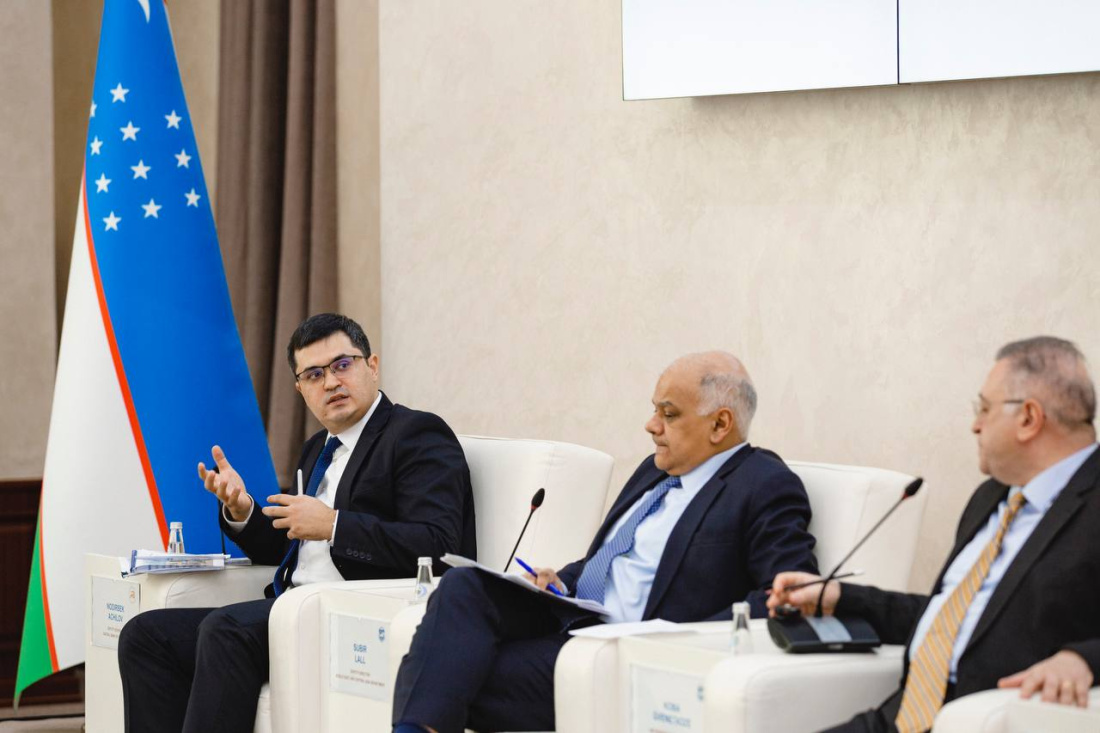
On February 27, 2026, the Central Bank of Uzbekistan, together with the International Monetary Fund, held a scientific conference on the Caucasus and Central Asia (CCA) Regional Economic Outlook and Uzbekistan’s macroeconomic developments.
Within the framework of the event, the following presentations were delivered:
Subir Lall (IMF) - “Economic Outlook of the Caucasus and Central Asia Region”;
Koba Gvenetadze (IMF) - “Uzbekistan’s Economy and Reform Agenda”;
Holger Floerkemeier (CCAMTAC) - “CCAMTAC’s Activities in Uzbekistan and Capacity-Building Initiatives.”
University students from several institutions attended the conference, gaining insights into regional and national macroeconomic trends.
During the conference, the IMF noted that most CCA economies remained resilient in 2025. Growth was supported by higher oil production, strong remittances, and tourism. While headline inflation increased in many countries and exchange rates depreciated, inflation is projected to decline gradually over the medium term.
Regional growth projections for 2026 were revised upward compared to April 2025 estimates. The IMF emphasized rebuilding fiscal buffers, maintaining tight monetary policy where needed, strengthening fiscal frameworks, and reinforcing central bank independence.
The IMF notes that, Uzbekistan’s economy has remained strong and resilient. Real GDP grew robustly by 7.7% in 2025, largely supported by strong domestic demand. Growth is projected at 6.2% in 2026, underpinned by continued strength in private consumption and investment. The IMF notes that maintaining structural reforms will be crucial to sustaining this robust growth. It also highlights that this is an opportune moment to strengthen efforts to safeguard macro-financial stability, enhance economic resilience, and advance reforms for long-term growth. These favorable macroeconomic developments have contributed to a significant decline in the poverty rate.
The Central Bank has maintained a 14 percent policy rate since March 2025 to ensure continued disinflation and macroeconomic stability.
The fiscal deficit is estimated at around 2 percent of GDP in 2025. Public and external debt have remained stable since 2020, and the risk of external debt distress is assessed as low in a joint analysis with the World Bank. International reserves stood at 13 months of prospective imports at end-October 2025.
Established in February 2021 in Almaty, Kazakhstan, CCAMTAC supports member countries in building strong economic institutions and macroeconomic management capacity. The IMF’s engagement is structured around policy assessment and advice, lending, and capacity development through technical assistance and training.
In Uzbekistan, CCAMTAC has provided support in several areas, including assistance to the State Committee on Statistics in developing data sources and methodologies for QNA compilation and publishing discrete time series for quarterly GDP. Also, support was provided on development of the interbank repo market, assessment and reporting of fiscal risks from state-owned enterprises, and strengthening fiscal cash management through support to the Treasury Service Committee.
The Scientific Conference provided a detailed assessment of macroeconomic developments in the CCA region and Uzbekistan, including updated growth and inflation projections, fiscal and external outlooks, institutional reforms, and capacity development initiatives. Presentations underscored the importance of strong fiscal frameworks, credible monetary policy, exchange rate flexibility, and institutional strengthening to ensure macroeconomic stability and sustainable growth. The conference concluded with an engaging Q&A session, giving university students the chance to ask questions and engage in discussion with the presenters.